
Jackson County Criminal Court Records
A Jackson County criminal court record is the case-level file kept by Jackson County District Court after charges are filed. The record can include the complaint or information, charge counts, bond orders, arraignment entries, plea events, motions, hearing notices, orders, disposition, sentencing, probation violations, financial obligations, and warrant or failure-to-appear entries. It is the official court file, not just a booking note or arrest listing.
Jackson County District Court is part of the Kansas 2nd Judicial District. It handles felony and misdemeanor cases filed at the state district court level. City ordinance violations and many local traffic matters may be in Holton Municipal Court or Hoyt Municipal Court instead. Federal criminal prosecutions are not Jackson County cases; they are handled in the U.S. District Court for the District of Kansas when federal jurisdiction exists.
The Jackson County Attorney is a key local office in the criminal case path. The County Attorney office is listed at 400 New York, Suite 400, Holton, with phone 785-364-3103. The prosecutor's filing decision can turn an arrest event into a court case, but the District Court record is where the filed charge, plea, disposition, and sentence are tracked.
The manifest image below comes from the Jackson County Attorney page.
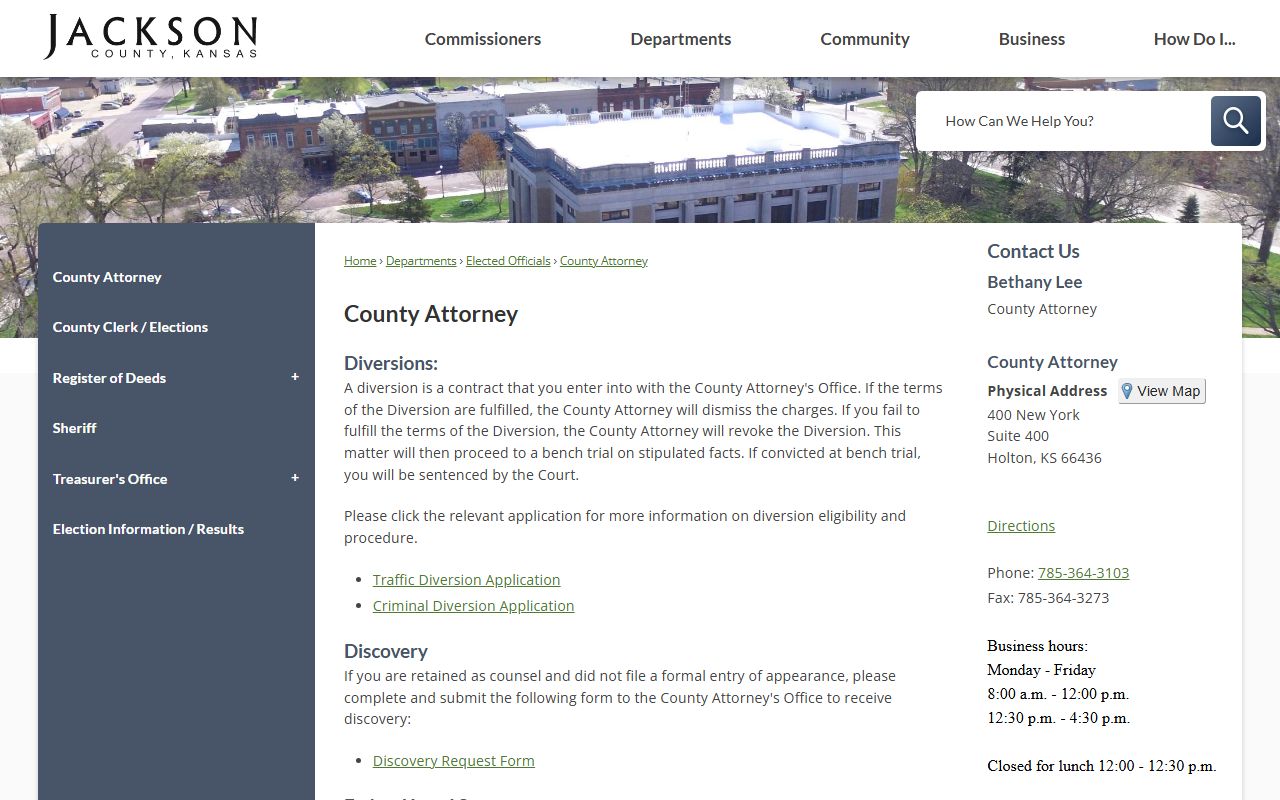
That office context matters because criminal court records begin when the prosecution files charges in the court system.
Search Jackson County Criminal Court Records
For Jackson County state criminal cases, start with Kansas CaseSearch. The portal is the official statewide district court search system and can be searched by case number, party name, business name, citation number, judicial officer, attorney, and other criteria available for the user's role. The official smart-search guidance says registration is required for Smart Search and that a case number or name is required.
- Open Kansas CaseSearch and sign in or register when prompted.
- Search by defendant name or case number. Use business name only when the party is an entity.
- Open Advanced Filtering Options and set location to Jackson County when available.
- Filter by criminal case type, filing date, case status, or judicial officer when needed.
- Read the docket for charges, arraignment, plea, motions, disposition, sentence, and later entries.
- Contact Jackson County District Court for certified copies, terminal-only documents, or web-unavailable public records.
KDOC KASPER, the Jackson County jail roster, warrant lists, and offender registries are not substitutes for the criminal court record. They can help identify custody status, warrants, or post-conviction supervision, but the District Court file is the source for the case record and court outcome.
Jackson County Criminal Case Flow
A criminal court record grows in stages. The docket often begins with a complaint or information and then records the first appearance or arraignment. Pretrial entries may show motions, continuances, discovery disputes, bond changes, diversion matters, or warrant activity. The final part of the case record shows whether the case ended through dismissal, plea, trial verdict, diversion completion, sentence, probation, or later enforcement.
Case flow: Charges Filed › Arraignment › Pretrial and Motions › Plea or Trial › Disposition › Sentencing
| Stage | What Happens |
|---|---|
| Charges Filed | The prosecutor files a complaint or information that opens the criminal case and lists alleged offenses. |
| Arraignment | The defendant is advised of charges and enters or later enters a plea. |
| Pretrial and Motions | The docket may show bond, discovery, continuances, motions, orders, and hearing settings. |
| Plea or Trial | The case resolves by plea, trial verdict, dismissal, diversion path, or other court action. |
| Disposition | The record states the outcome for each charge or count when available. |
| Sentencing | The court enters jail, prison, probation, fines, costs, restitution, or other terms when a conviction supports sentencing. |
The page for Jackson County arrest records and court charges focuses more closely on charge language and the arrest-to-charge path.
What Jackson County Criminal Records Show
The criminal court record should be read count by count. A single case can have more than one charge, and each charge can have a different result. One count may be dismissed while another ends in a plea. A sentence may include probation, jail time, financial obligations, restitution, or later probation violation entries. The docket can also show warrants and failure-to-appear entries, but an active warrant status should be checked with the sheriff or court before any action is taken.
| Field | What It Shows |
|---|---|
| Case Number | The Kansas criminal case identifier, using the current Odyssey format for newer cases or older pre-migration format for older files. |
| Defendant | The person charged in the criminal case, along with party role and attorney information when shown. |
| Charges | The alleged offenses, counts, statute references, severity level, and amended or dismissed charge entries when posted. |
| Bond | Bond amount, bond conditions, custody-related orders, or later changes when entered in the docket. |
| Plea | Guilty, not guilty, no contest, diversion-related entries, or other plea events. |
| Motions and Orders | Requests filed by parties and the judge's rulings or written directives. |
| Disposition | The outcome for the case or charge, such as dismissed, guilty, not guilty, diversion, or closed status. |
| Sentence | Probation, jail, prison, fines, costs, restitution, fees, or other court-ordered terms. |
Charges vs Convictions
A charge is an allegation filed in court. A conviction is an outcome reached through a guilty plea, no contest plea accepted by the court, or trial verdict. Jackson County criminal court records can show both, which is why a docket must be read through the disposition and sentence rather than stopping at the charging entry. The Jackson County jail roster disclaimer also warns that an arrest does not mean conviction and does not imply guilt or innocence.
| Point | Charge | Conviction |
|---|---|---|
| Meaning | An alleged offense filed or listed against a person. | A finding or accepted plea of guilt for an offense. |
| Timing | Appears near the start of the case or after amendment. | Appears after plea, trial, or other final court action. |
| Record impact | May be dismissed, amended, reduced, or left unresolved until disposition. | Can support sentencing, probation, fines, restitution, and later enforcement. |
| How to verify | Read the charge entry and later docket activity. | Read disposition and sentencing entries for each count. |
Note: Do not treat a Jackson County criminal charge as a conviction unless the case disposition supports that conclusion.
Criminal Court Records Access Rules
Adult criminal court records are often public, but access is shaped by Kansas public-record law, court access rules, redaction rules, and case-specific orders. K.S.A. 45-216 states the Kansas public policy favoring open records unless otherwise provided by law. Kansas Supreme Court Rule 22 governs public electronic access to district court and appellate case records. Those rules help explain why a case summary can be public while a specific document is not visible online.
Copy fees and certification procedures should be checked with Jackson County District Court because the research did not locate a county-specific copy-fee table for criminal case records. The court's access channels include Kansas CaseSearch, the Room 311 counter or terminal in Holton, phone at 785-364-2191, mail to the District Court, and the records request email identified in official snippets as jadc@kscourts.gov.
The manifest image below comes from K.S.A. 21-6614, the Kansas criminal expungement statute source.
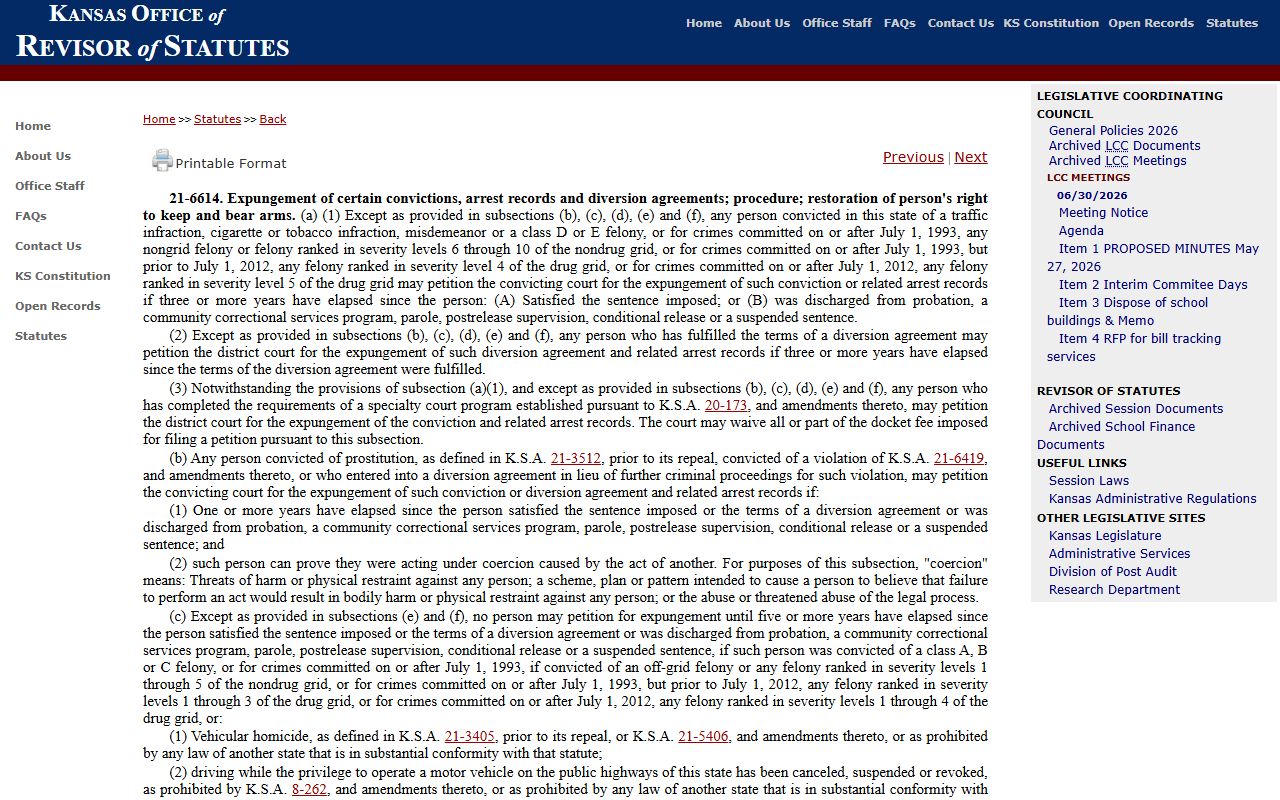
That statute matters after a criminal case because an expungement order can limit ordinary public access to qualifying records.
Sealed vs Expunged Criminal Records
Sealed and expunged records are not the same. A sealed criminal record is hidden from ordinary public access by a court order or law. An expunged Kansas criminal record is subject to access limits after a qualifying petition and court order. Expungement does not always erase the event for every purpose. Law enforcement and criminal justice agencies may still have access in defined circumstances.
| Point | Sealed | Expunged |
|---|---|---|
| Public view | Not open to the public unless law or court order permits access. | Ordinary public access is limited after the court grants expungement. |
| How it happens | By statute, confidentiality rule, or court order. | By petition in the court with jurisdiction and a granted expungement order. |
| Common examples | Juvenile, adoption, care and treatment, or specially protected documents. | Eligible criminal records under K.S.A. 21-6614 or certain arrest records under K.S.A. 22-2410. |
| Jackson County path | Contact the court that holds the file. | Start with Jackson County District Court for a district court criminal case. |
The arrest-record expungement source in the manifest is K.S.A. 22-2410.
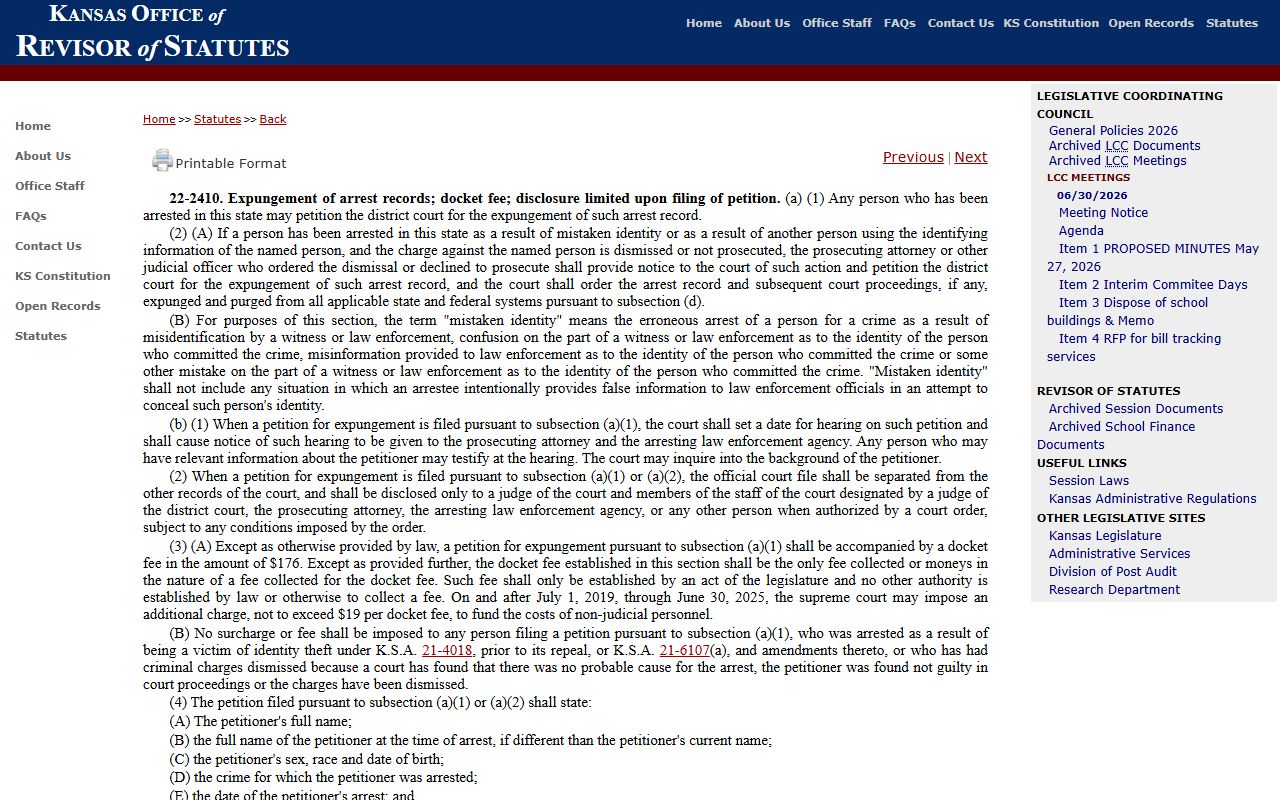
That source is tied to arrest-record expungement, while the court case file may also involve criminal expungement rules once a case has been filed.
Restricted Jackson County Criminal Records
Juvenile offender records have special access rules in Kansas and should not be treated like ordinary adult criminal court records. The public portal guide also lists juvenile and related case categories that are not available through the public portal. Some search warrants, grand jury materials, inquisition records, care and treatment files, and protected personal data may be restricted, sealed, redacted, or withheld from web access.
The juvenile offender source in the manifest is K.S.A. 38-2309.
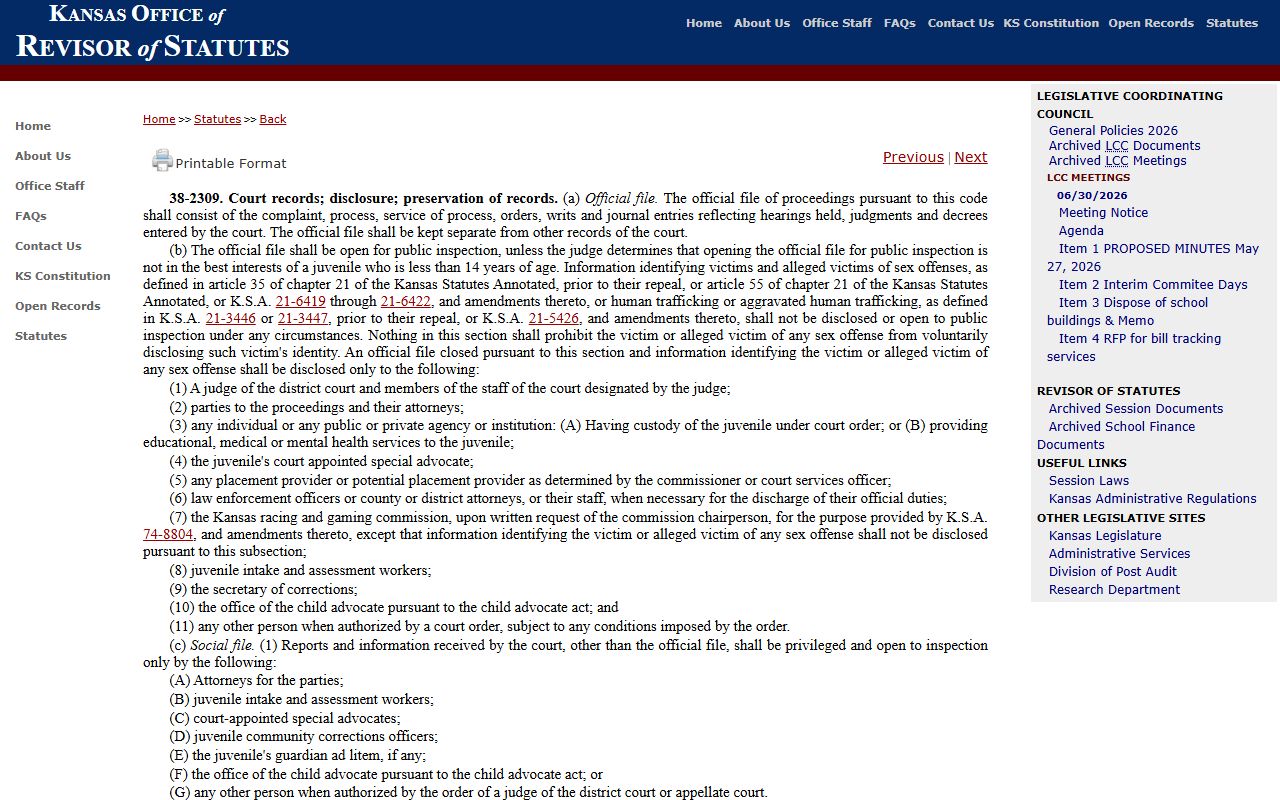
That juvenile-record rule is a key reason a Jackson County criminal search should separate adult public cases from juvenile or protected records.
Federal Criminal Record Fallback
Federal criminal matters involving Jackson County people or events are not filed in Jackson County District Court unless there is a separate state case. Federal prosecutions are handled by the U.S. Attorney's Office for the District of Kansas and filed in the U.S. District Court for the District of Kansas. Federal warrants, prisoner transport, courthouse security, and fugitives involve the U.S. Marshals Service District of Kansas. Federal custody is searched through the Bureau of Prisons inmate locator, not the Jackson County jail roster.
The manifest image for this federal context comes from the U.S. Attorney's Office for the District of Kansas.
That federal source is a fallback only when the criminal matter belongs to federal court rather than Jackson County District Court.